Opening Reflection: What the Room Taught Me
I’ve been in a lot of rooms. Boardrooms, conference rooms, breakout sessions, and the kind of rooms where people are quietly carrying more than anyone around them knows. But there is a particular kind of room that changes you before the event even begins.
A few weeks ago, I had the privilege of sitting down with the team at the Foundation for Wellness in their new office in Lafayette, Louisiana. I walked in as a speaker preparing for the upcoming Wellness Summit. I walked out as something more: a person genuinely moved by what this organization is building and why.
What struck me first was the space itself. There was an intention to it that you feel before you can fully explain it. Then the conversation began, and I understood why. The Foundation for Wellness team doesn’t just talk about their programs. They live inside them. They spoke about their mission with the kind of quiet conviction that doesn’t need to be performed because it is simply true. They walked me through their community work, their upcoming Summit, and every project they touch, down to the tiniest detail, and not one felt like a task. Everything felt like a calling.
I left that meeting inspired, not just as a speaker preparing for a session, but as a person being reminded of what it looks like when we pour genuine purpose into everything we do.
That meeting became the heartbeat of this edition of The Culture Catalyst. Because what I witnessed in that Lafayette office is exactly what we talk about here every month: the kind of culture that is built not by policy or program alone, but by people who are fully present to their purpose.
If you haven’t heard of the Foundation for Wellness, I encourage you to change that today. Visit their website at foundationforwellness.com, reach out, and find a way to get involved.
You don’t have to attend the Wellness Summit to be part of what they are doing, though I hope you will consider it. Their work touches healthcare professionals, communities, and individuals navigating the kind of challenges that rarely get named out loud. They are doing something rare, and they deserve an audience that matches their mission.
I am honored to join them at the Wellness Summit on May 29–31 in Point Clear, Alabama, as a speaker and panelist. And I can say with complete honesty that the moment I will carry with me the longest from this experience may not be as a presenter. It may be from a quiet afternoon in a Lafayette office, sitting across from people who reminded me why this work matters.
This month, we’re exploring what it means to design growth from the inside out — and I want to introduce you to the framework that has become the heartbeat of everything we do at People by Design.
With purpose, Melissa Montgomery, M.S., BPC, EQAC Founder, People by Design
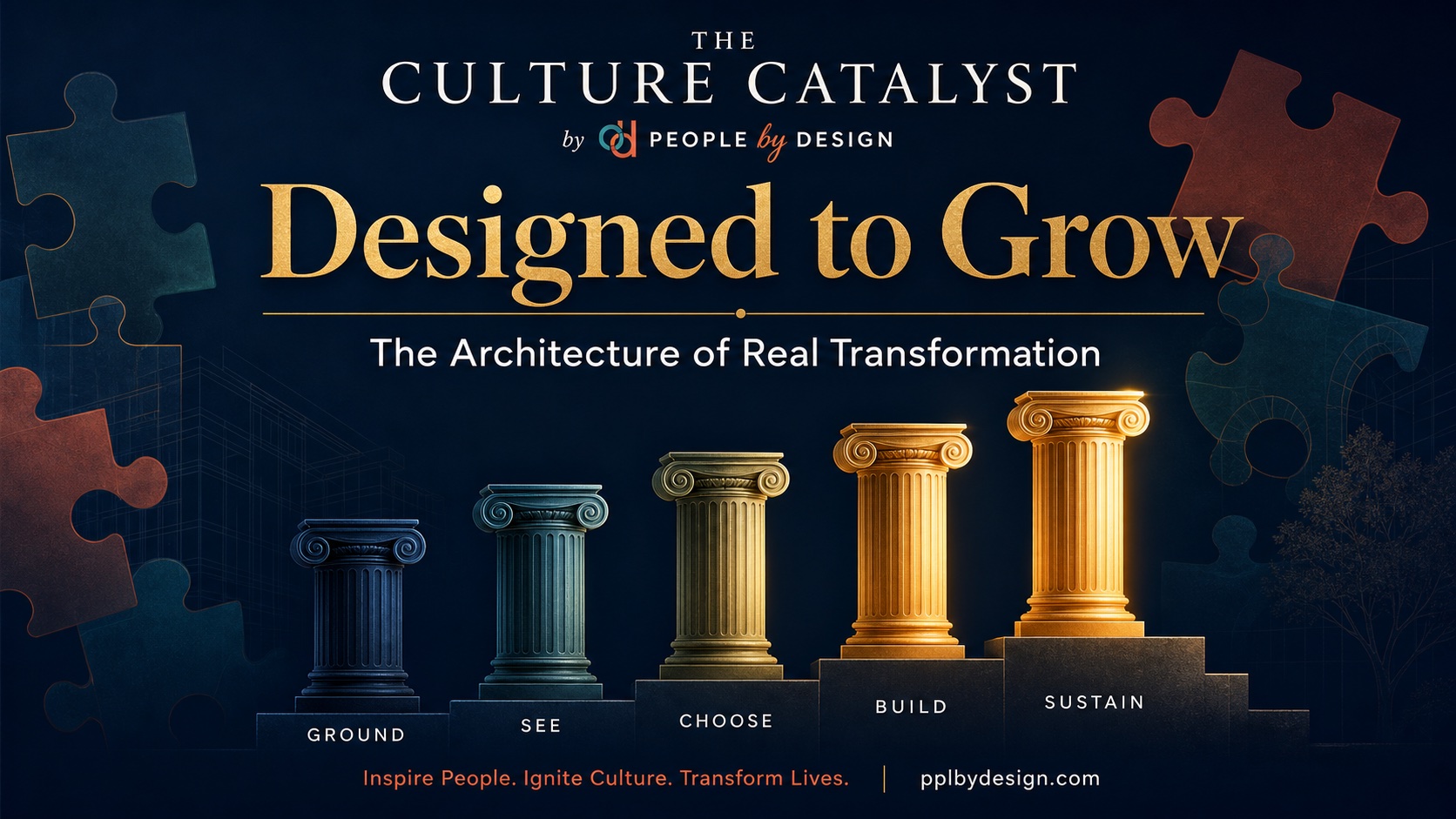
Designed to Grow: The Architecture of Real Transformation
Viktor Frankl wrote that between stimulus and response, there is a space. In that space lies our freedom and our power to choose our response. In that choice lies our growth and our happiness. That one idea has outlived entire management philosophies. And yet most leadership development programs skip right over it. They hand people a model, a framework, a competency map, and send them back into a world that continues to trigger the same old patterns at the same relentless pace.
We wonder why nothing changes. Real transformation doesn’t happen in a workshop. It doesn’t happen in a keynote. It happens in that space Frankl wrote about, practiced over time, with support, structure, and the kind of honest self-awareness most of us have been quietly avoiding. That is what Coaching by Design was built to create.
A Framework Built for Real Life
At People by Design, we believe that growth has an architecture. Not a checklist. Not a personality type. Not a set of traits you either have or don’t. An architecture — meaning a structure that can be designed, built, and sustained by anyone who is willing to do the work.
Coaching by Design is our proprietary five-phase coaching methodology, developed from more than 20 years of HR and leadership experience, grounded in evidence-based emotional intelligence assessment and development, and shaped by the very personal understanding that transformation is rarely linear and always deeply human.
The framework moves through five intentional phases: Ground. See. Choose. Build. Sustain. Rather than giving you the entire blueprint here, let me offer you what it feels like from the inside.
It begins with trust — not as a given, but as something built deliberately. Before we explore where you’re going, we understand where you are: who you are beyond your job title, and what has shaped the way you lead, relate, and respond. Simon Sinek asks us to start with Why. We go further. We start with who. Because your Why will always be filtered through who you believe yourself to be.
Then comes the most uncomfortable and the most liberating part: learning to see yourself clearly. Not harshly. Clearly. Brené Brown has spent decades showing us that self-awareness without self-compassion produces shame, not growth. This phase is not about cataloging your failures. It is about standing honestly in your own story, recognizing the patterns that have served you and the ones that no longer do.
James Clear says you don’t rise to the level of your goals. You fall to the level of your systems. The middle phases of our model are exactly that: designing systems, practicing new behaviors, building accountability structures that make change durable and not dependent on willpower alone. Patrick Lencioni taught us that an organization’s health is its greatest competitive advantage. The same is true for a person. The goal is not a one-time breakthrough. It is a healthier operating system.
And then, in the final phase, we do something that most coaching engagements skip entirely: we anchor the growth so it travels with you after the formal work is done.
The EQ Thread That Runs Through Everything
Emotional intelligence is not a module within Coaching by Design. It is the lens through which every phase is experienced. As a Six Seconds Certified Brain Profiler and EQ Assessor, I integrate evidence-based EQ assessments into coaching engagements not as evaluations, but as maps. They help clients see the emotional patterns that are running in the background of every decision, every relationship, and every leadership moment.
Daniel Coyle, in The Culture Code, identified three things that the highest-performing teams in the world share: safety, vulnerability, and purpose. What he found in teams is exactly what emotionally intelligent individuals carry inside themselves.
“You cannot build a culture you haven’t first cultivated within.”
Will Guidara transformed one of the world’s great restaurants around a single radical idea: that unreasonable hospitality — caring for people beyond what is expected or required — is both a differentiator and a discipline. In coaching, this shows up as the decision to treat every client not as a problem to be solved but as a person to be seen. That is not soft. It is profoundly strategic.
What This Means for You
Whether you are an executive navigating the weight of organizational change, a healthcare professional staring down burnout, a team leader trying to build real trust within your department, or someone simply ready to lead their own life with more intention — the Coaching by Design framework meets you there.
John Maxwell has spent a lifetime studying the laws of leadership, and perhaps none is more foundational than this: everything rises and falls on leadership. We would add one word. Everything rises and falls on self-aware leadership. Because the leader who does not know themselves will inevitably recreate the same environment wherever they go, regardless of how many new strategies they implement.
The five phases of Coaching by Design exist to interrupt that cycle. To create space for the kind of growth that is not just aspirational but architectural: designed, built, and built to last. If this framework raises questions for you, that is exactly the point. We would love to have that conversation. Learn more about Coaching by Design at pplbydesign.com.
This Month’s Spark: The Space Between
Frankl’s observation gives us one of the most actionable leadership invitations that exists: locate the pause.
This week, choose one recurring situation where you consistently react rather than respond. A meeting that frustrates you. A conversation that triggers defensiveness. A request that lands like an accusation.
Before you respond in that moment, take a breath and ask yourself one question:
“Is this response coming from my values, or from my history?”
That single question is the beginning of Coaching by Design. And it is available to you right now — without a program, without a certification, and without anyone’s permission.
What’s one moment this week where you could choose your response instead of defaulting to your reaction?
People by Design Podcast: Coaching From the Inside Out
This month on the People by Design Podcast, we explore what it actually feels like to move through the five phases of growth — and why most people stall at the second one.
The episode features a candid conversation about self-awareness: the kind that is uncomfortable enough to be useful, and what happens when leaders finally stop performing confidence and start building it.
“You cannot lead people to a place of honesty you haven’t been willing to go yourself. Vulnerability isn’t the destination. It’s the door.”
Listen, subscribe, and share with someone in your circle who is ready for a real conversation about what growth actually requires.
Search: People by Design Podcast — Available on Spotify
From Melissa’s Desk
There is no shortage of leadership content in the world. Books, frameworks, keynotes, courses, and certificate programs are abundant. And yet the research consistently shows that knowledge alone does not change behavior. Insight without structure fades. Intention without accountability dissolves.
What changes people is what has always changed people: a relationship built on trust, a mirror held with compassion, and a structure that makes new choices possible over time. That is Coaching by Design. And it is built for you.
“The curious paradox is that when I accept myself just as I am, then I can change.” — Carl Rogers
Thank you for reading, for reflecting, and for the work you do every day to make the people around you better. That work matters more than you know.
With gratitude, Melissa Montgomery, M.S., BPC, EQAC Founder, People by Design
Connect with People by Design
Visit pplbydesign.com or follow us on LinkedIn to learn more about our coaching, workshops, and upcoming insights on emotional intelligence and human-centered growth.
Ready to start a conversation? Let’s connect.
People by Design — where growth begins with belonging.